Balancing and alignment are sold side by side, quoted in the same breath, and confused constantly, because both involve wheels, both are done in a front-end shop, and both affect how a car feels at speed. They are not the same job. One corrects weight distribution in a spinning wheel. The other sets the angles at which the wheels meet the road. Paying for the wrong one leaves the symptom untouched.
For Gastonia drivers, Wink's Front End Shop draws the line this way: vibration questions start with balance, pulling and wear questions start with alignment. The calendar below shows when each job naturally comes due across the year of a car's life.
Two different problems, two different machines
A wheel and tire are never perfectly uniform in weight. At speed, a heavy spot acts like a small hammer blow once per revolution, which the driver feels as a vibration in the steering wheel from a front wheel, or in the seat from a rear one, typically appearing in a speed band around highway pace and sometimes fading above it. Balancing fixes that by spinning the assembly on a balancer and adding small weights to cancel the heavy spot. No angles are measured or changed.
Alignment measures toe, camber, and caster, the angles that decide whether tires roll straight, wear evenly, and return to center after a turn. Its symptoms are pulling, a crooked steering wheel, and patterned tire wear, not vibration. A car can be perfectly aligned and still shake from imbalance, and perfectly balanced while wearing its tires to cords from bad toe. The machines, the skills, and the fixes do not overlap.

When each job comes due across the year
| When | Balancing | Alignment |
|---|---|---|
| New tires fitted | Always, every new tire is balanced at mounting | Recommended check, so new tires start life on true angles |
| At rotation, roughly every 6 months | Recheck if any vibration has appeared; weights can be lost | Good moment for an annual angle check in rotation years |
| After a pothole strike or curb hit | If a weight was knocked off or the wheel bent, vibration follows | Yes, impacts are the classic cause of shifted toe |
| After suspension or steering parts | Not required by the parts themselves | Yes, parts replacement unsettles the geometry as a rule |
| When symptoms appear | Steering wheel or seat vibration in a speed band | Pulling, crooked wheel, or one-sided tread wear |
Where the confusion costs money
The classic waste is balancing tires to cure a pull, or aligning a car to cure a shake. Each job completes perfectly and the complaint survives intact, because the cause was in the other column. There are border cases worth knowing: a bent wheel can cause both vibration and wear, severe cupping from worn struts vibrates and looks like an alignment story, and a tire with internal damage can shake in ways no amount of weight fixes. A good shop in Gastonia will road test first, name which column your symptom lives in, and test the border cases rather than selling both jobs by default.
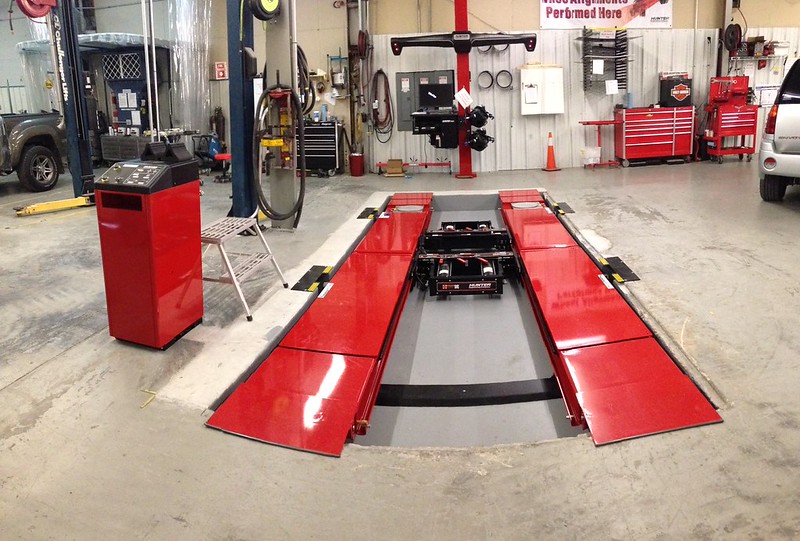
How to ask for the right job
Describe the symptom with speed and location: shake in the wheel at 60, drift to the right on flat roads, wheel off center since spring. That sentence tells a technician which machine your car belongs on. If new tires are going on, expect balancing as part of fitting and treat an alignment check as cheap insurance for the new tread. Kept straight, the two jobs stop being a package you are sold and become two tools you use on purpose, each when its symptom or its season arrives.
Weights deserve a footnote of their own. Balancers use small adhesive or clip-on weights, measured in fractions of an ounce, and a wheel that needed a large amount of weight to balance may be telling on a bent rim or a tire mounted off its mark. Good technicians rotate a suspect tire on the rim to reduce the weight needed rather than stacking more on, a step called road force or match balancing in its fuller form. If a shop mentions unusually heavy weight on one wheel, ask them to check that wheel for a bend before accepting the balance as final, because weight can mask a shape problem only up to a point.
Common questions
Can bad alignment cause vibration?
Not directly. Misalignment causes pulling and wear. Vibration at speed is usually imbalance, a bent wheel, or tire damage, though wear caused by misalignment can eventually add roughness.
Should tires be balanced every time they are rotated?
Not automatically. Balance is checked when vibration appears or weights are lost, and many shops will recheck balance at rotation if there is any complaint. Rotation itself does not change balance.
Do new tires need an alignment?
They need balancing at fitting, always. An alignment check is strongly recommended so the new set does not inherit wear patterns from bad angles, especially if the old tires wore unevenly.
Photos in this guide are representative stock images.
← All guides from Wink's Front End Shop← Back to Wink's Front End Shop